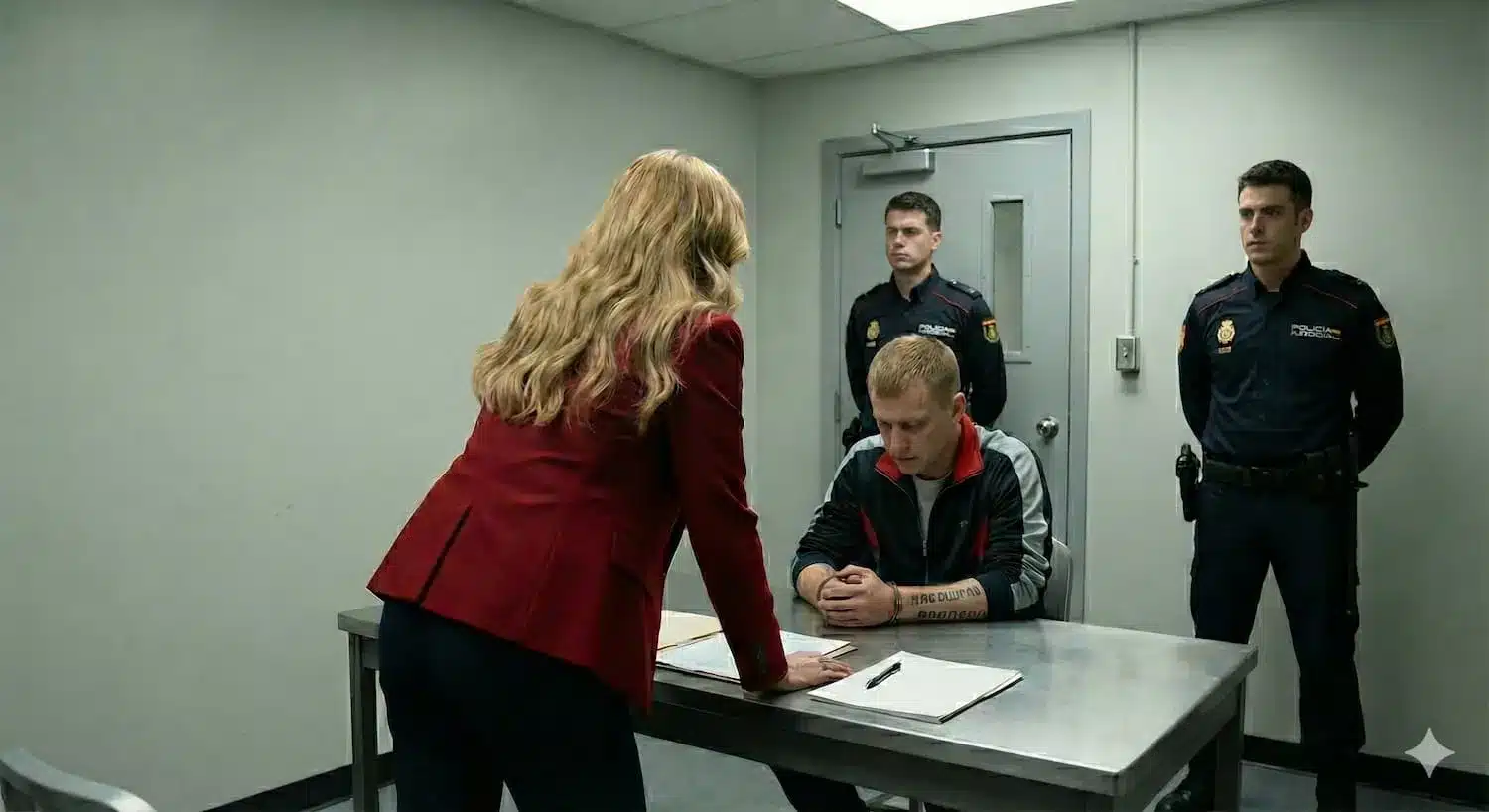
Celeste Pérez Bleda, criminal lawyer in Alicante: criminal defence and private prosecution before the courts of Alicante and its province. Assistance for arrested persons 24 hours a day, with more than 20 years of experience in Criminal Law.
Defending an accused person is more than a job; it is a commitment to justice. I fight for your freedom, so that your rights are respected and the truth prevails, with rigour and humanity.
Celeste Pérez Bleda
Criminal lawyer · More than 20 years of experience in Criminal Law Member No. 7301 of the Alicante Bar Association (Ilustre Colegio de la Abogacía de Alicante)
Every offence and every stage of criminal proceedings
We defend people under investigation and accused persons, and we represent victims as private prosecutors. From the police station to the Supreme Court.
We defend women who are victims of gender violence and men accused in domestic violence proceedings, with immediate assistance on WhatsApp 24 hours a day.
We handle emergencies 24 hours a day: police station, Guardia Civil post or duty court.
02
Case review
We review the police report, the complaint or the case file and explain clearly where you stand.
03
Written strategy
We propose a strategy and a personalised quote before we begin.
04
Defence to the very end
We stand by you at every statement, hearing and appeal until the final decision.
Confidentiality
Everything you tell us is protected by professional secrecy.
Speed
In criminal cases, the first few hours are decisive. We act from the moment we are contacted.
Rigour
More than 20 years in Criminal Law before the courts of Alicante.
Foreigners and tourists
Arrested in Alicante and don't speak Spanish?
We defend foreign residents and tourists arrested in Alicante, at the airport or anywhere on the Costa Blanca: interpreter, notifying your consulate, speedy trials and the risk of expulsion. Our team will assist you in your language.
English · Français · Deutsch · Nederlands · Русский · Українська · Română · Shqip · العربية · 中文 · Polski · Svenska · Norsk
Yes. Our WhatsApp number, 607 449 491, is available 24 hours a day, every day. A family member can message us on WhatsApp and appoint us as the arrested person’s lawyers; from that moment we go to the police station or the duty court.
Among others, the right to remain silent, not to incriminate yourself, to be assisted by the lawyer of your choice, to speak with them in private and to have a family member informed. These rights are set out in Article 520 of the Criminal Procedure Act (Ley de Enjuiciamiento Criminal).
Our team works in Spanish and, through the website and partners, in English, French, German, Dutch, Russian, Ukrainian, Romanian, Albanian, Arabic, Chinese, Polish, Swedish and Norwegian.
Cases are personally handled by Celeste Pérez Bleda, a lawyer registered with the Alicante Bar Association (Ilustre Colegio de Abogados de Alicante) under no. 7301, with 20 years of experience in criminal law. From the first consultation you will speak directly with her; she will study your case, explain clearly where you stand and what your options are, and support you at every stage of the proceedings, from the police station or the court to the trial.
It makes a big difference. As a person under investigation (investigado) you can remain silent, not testify against yourself and always make your statement assisted by a lawyer of your own choosing (art. 118 of the Spanish Criminal Procedure Act, LECrim). As a witness you are obliged to attend and to tell the truth (arts. 410 and 433), unless an exemption covers you, such as the one for certain relatives of the accused (art. 416). Read the summons carefully and prepare your statement with a lawyer.
It is possible in many cases. The judge can suspend prison sentences of no more than two years if it is reasonable to expect that you will not reoffend (art. 80 of the Spanish Criminal Code). As a general rule, it requires that it is your first offence, that the penalty or the sum of the penalties does not exceed two years and that you have paid, or undertake to pay, the civil liability. The suspension lasts from two to five years (art. 81) and can be revoked if you commit a new offence during that time (art. 86). We explain your options.
You can choose. Article 118 of the Spanish Criminal Procedure Act (LECrim) gives every person under investigation the right to freely appoint a lawyer (except for a person held incommunicado under art. 527). Only if you do not appoint one and request it, or when necessary, will a duty lawyer be assigned to you. The same article sets out your right to request free legal aid if you meet the legal conditions.
In general, yes: under article 118.3 of the Spanish Criminal Procedure Act (LECrim), the person under investigation must be defended by a lawyer and represented by a court representative (procurador) to act in the proceedings. The exception is trials for minor offences, where article 967 allows you to attend without a lawyer, unless the minor offence carries a fine with a maximum of at least six months. Even so, having a defence lawyer is usually wise.
Yes. Article 118.4 of the Spanish Criminal Procedure Act (LECrim) establishes that all communications between the person under investigation and their lawyer are confidential, and if they are recorded by mistake during an investigation the judge must order them to be deleted. In addition, article 416 exempts the lawyer from testifying about facts their client has confided in them as defence counsel. You can tell the whole truth without fear: that is what makes it possible to prepare a good defence.
They are measures the judge adopts before the judgment, such as prohibiting you from approaching or communicating with someone (art. 544 bis of the Spanish Criminal Procedure Act, LECrim). Pre-trial detention is the most serious: it is only possible if it is objectively necessary and no other less burdensome measure is sufficient (art. 502) and, as a rule, it requires an offence with a maximum penalty of two years or more and a specific purpose, such as preventing flight or protecting the victim (art. 503). It is decided at a hearing with your lawyer present (art. 505).
It depends on the penalty the law assigns to each offence (art. 13 of the Spanish Criminal Code). Under article 33, an offence is serious if it is punishable, for example, by more than five years in prison; less serious if punishable by three months to five years in prison or a fine of more than three months; and minor if punishable by a fine of up to three months, among other lesser penalties. The classification affects the procedure, the limitation period and the criminal record.
Yes, by means of an appeal (recurso de apelación), but the time limits are short and depend on the type of proceedings: ten days from notification if the judgment was given by the Criminal Court (Juzgado de lo Penal) (art. 790 of the Spanish Criminal Procedure Act, LECrim) and five days in fast-track trials (art. 803) and in trials for minor offences (art. 976). Judgments given at first instance by the Provincial Court (Audiencia Provincial) are appealed before the High Court of Justice (Tribunal Superior de Justicia) (art. 846 ter). We review your judgment before the time limit expires.
If you are arrested and do not choose a lawyer, a duty lawyer will assist you (art. 520.5 of the Spanish Criminal Procedure Act, LECrim) without you first having to prove your lack of resources, although if you are later not granted free legal aid you will have to pay their fees (art. 6.2 of Spanish Law 1/1996 on Free Legal Aid). Free legal aid is granted if you lack sufficient assets and your gross annual income does not exceed twice the public income indicator (IPREM) if you live alone, or two and a half times or three times depending on your family (art. 3). Tell us about your situation.
Yes, by means of a plea agreement (conformidad): you accept the most serious charge and the judge gives judgment if the legal classification and the penalty are correct and your agreement is freely given (arts. 785 and 787 ter of the Spanish Criminal Procedure Act, LECrim). In a fast-track trial the penalty requested is reduced by one third if the offence carries a penalty of up to three years in prison, the reduced penalty does not exceed two years and there is no private prosecution (art. 801). Afterwards there is hardly any possibility of appeal, so weigh it up with your lawyer.
Bring everything you have in writing: the summons or notification from the court, the complaint or the police report if you were given it, any court decision (orders, judgments, restraining orders) and your DNI, NIE or passport. Add anything that may support your version: messages, emails, photos, medical reports, contracts or the details of possible witnesses. A short account in date order helps a great deal. If a time limit is running, book an appointment as soon as possible.
We assist clients in Alicante and throughout the province
We handle criminal cases throughout the province of Alicante, wherever you live and whichever court is handling your case. These are some of the towns where we work most often:
AlicanteElcheSan Vicente del RaspeigSant Joan d’AlacantEl CampelloMutxamelBenidormTorreviejaAlcoyDeniaCalpeAnd any other town in the province
Contact
Tell us about your case. We'll get back to you right away.
Business Centre · Antigua Casa del Mar Avda. Perfecto Palacio de la Fuente, 1 · 03001 Alicante
Manage Cookie Consent
To provide the best experiences, we use technologies like cookies to store and/or access device information.
Functional
Always active
The technical storage or access is strictly necessary for the legitimate purpose of enabling the use of a specific service explicitly requested by the subscriber or user, or for the sole purpose of carrying out the transmission of a communication over an electronic communications network.
Preferences
The technical storage or access is necessary for the legitimate purpose of storing preferences that are not requested by the subscriber or user.
Statistics
The technical storage or access that is used exclusively for statistical purposes.The technical storage or access that is used exclusively for anonymous statistical purposes. Without a subpoena, voluntary compliance on the part of your Internet Service Provider, or additional records from a third party, information stored or retrieved for this purpose alone cannot be used to identify you.
Marketing
The technical storage or access is required to create user profiles to send advertising, or to track the user on a website or across several websites for similar marketing purposes.