Criminal lawyer in Alicante  /  Gender violence  /  International divorce with violence

Family and nationality

International divorce with gender violence in Alicante

When an international divorce involves gender violence, we coordinate the criminal and family proceedings to protect the victim and the children, even if the other parent lives in another country.
Celeste Pérez Bleda, Gender-based violence lawyer in Alicante
Reviewed by Celeste Pérez Bleda, Bar member no. 7301 · Updated October 2026
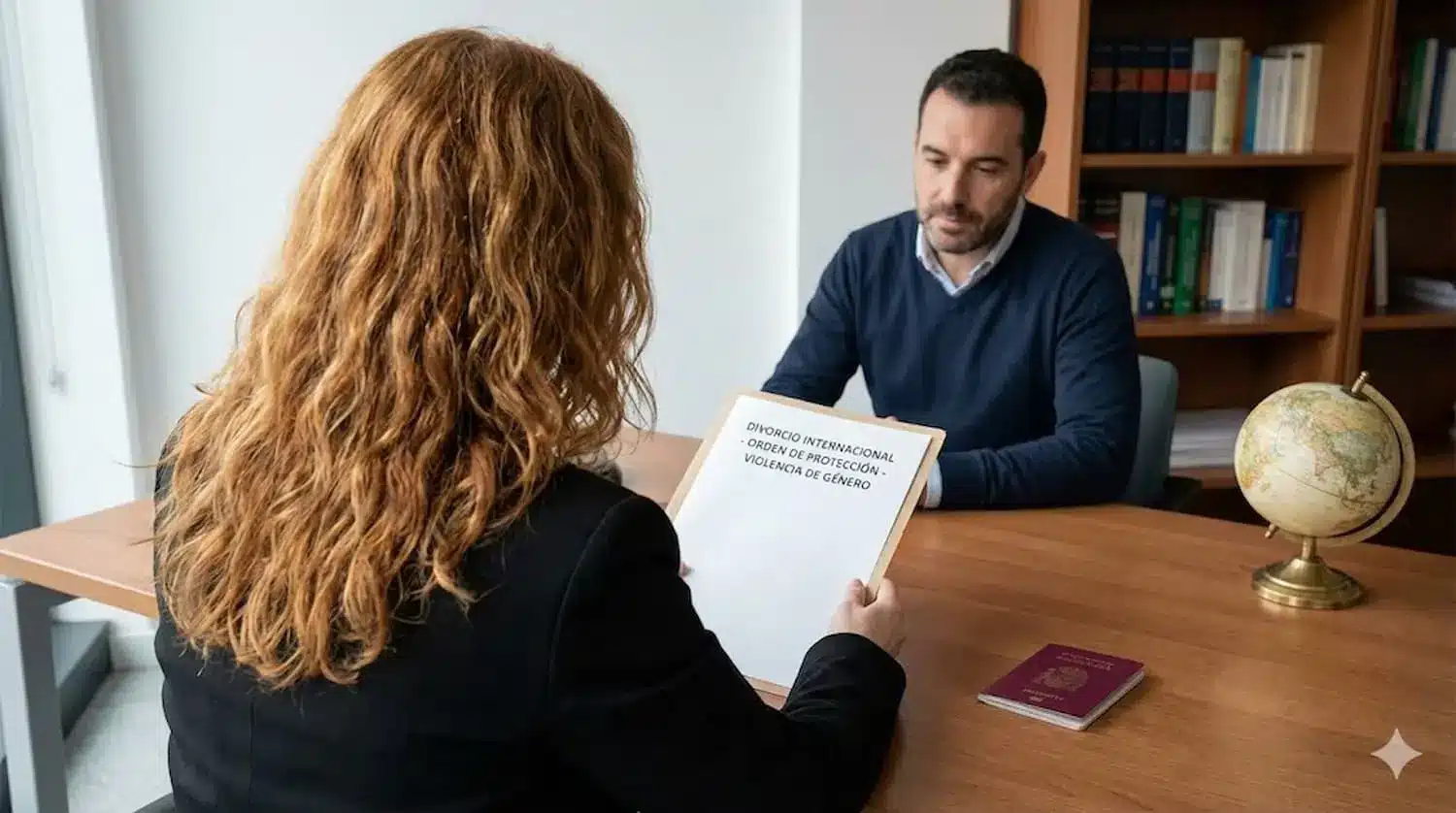
Female lawyer reviewing an international divorce document with a client in her office

In short

A divorce with international elements raises three questions: which courts have jurisdiction, which law applies and how the judgment will be recognised in other countries. Within the European Union, jurisdiction in divorce and parental responsibility is governed by Regulation (EU) 2019/1111, the law applicable to divorce by Regulation (EU) No 1259/2010 (Rome III) and maintenance by Regulation (EC) No 4/2009. If there are criminal proceedings for gender violence, the family case is heard by the Violence against Women Section (Sección de Violencia sobre la Mujer).

Which court decides and which law applies

Having married in another country, or the spouses holding another nationality, does not prevent you from divorcing in Spain. The deciding factor is usually habitual residence:

  • Jurisdiction: Regulation (EU) 2019/1111 (Brussels II ter) determines which European courts can hear the divorce and matters of parental responsibility.
  • Applicable law: Regulation (EU) No 1259/2010 (Rome III) allows the spouses to choose the law and, if they have not chosen, mainly applies the law of their habitual residence.
  • Assets: the matrimonial property regime is governed by Regulation (EU) 2016/1103, which is decisive when there is property in Spain and abroad.
  • Maintenance: maintenance is governed by Regulation (EC) No 4/2009, which makes it easier to claim across countries.

Children and moving abroad

Moving a child’s residence to another country requires the agreement of both parents or a court’s authorisation. When a child is wrongfully removed or retained, the 1980 Hague Convention on international child abduction allows you to request the child’s immediate return.

International divorce involving gender violence

If there is a complaint or open criminal proceedings, the divorce and the measures concerning the children are dealt with by the Violence against Women Section (Sección de Violencia sobre la Mujer), and mediation is prohibited. We coordinate both sets of proceedings so that the protection measures are also reflected in the family case and, if necessary, can be enforced in another European Union Member State.

Frequently asked questions

Yes, if the Spanish courts have jurisdiction, usually because one or both spouses are habitually resident in Spain. A foreign marriage may first need to be registered with the Spanish Civil Registry (Registro Civil).

The law you have validly chosen or, if no choice has been made, the law indicated by the Rome III Regulation, which gives priority to the law of the spouses’ common habitual residence.

Yes. Article 144 of the Spanish Civil Procedure Act (Ley de Enjuiciamiento Civil) requires a translation to accompany any document written in another language. It can be a private translation, but if the other party challenges it within five days, an official one will be requested at the expense of whoever submitted it. In addition, for a foreign public document to be valid as such it usually needs legalisation or an apostille, unless a treaty or a special rule exempts it (article 323).

Not because of that complaint. Under article 31 bis of Spanish Organic Law 4/2000, if your irregular status comes to light when you report gender-based violence, no penalty proceedings will be opened on that basis and any existing proceedings will be suspended, as will the enforcement of any expulsion order. Only if the criminal proceedings end without violence being established would those proceedings be opened or continued (article 31 bis.4).

Yes. Article 31 bis.3 of Spanish Organic Law 4/2000 allows you to apply for a residence and work permit on exceptional grounds as soon as a protection order is issued in your favour or there is a report from the public prosecutor indicating violence. The final permit is decided when the criminal proceedings end, but in the meantime a provisional permit is granted.

Yes. Under article 31 bis.3 of Spanish Organic Law 4/2000, you can apply for a residence permit for your minor children or children with a disability, and a residence and work permit if they are over sixteen, provided they were in Spain when you reported. They can also receive provisional permits while the criminal proceedings are being decided.

Not necessarily. Article 19.2 of Spanish Organic Law 4/2000 allows a spouse who came through family reunification and is a victim of gender-based violence to obtain an independent residence and work permit, without proving financial means, as soon as she has a protection order or a report from the public prosecutor indicating violence.

You can request measures against child abduction. Under articles 103 and 158 of the Spanish Civil Code, the judge can prohibit the children from leaving Spain without court authorisation, prohibit a passport from being issued to them or withdraw it, and require prior authorisation for any change of address. These measures can be ordered in the divorce or in any other proceedings.

Yes. Article 225 bis of the Spanish Criminal Code punishes a parent who abducts their minor child without justification with two to four years in prison and disqualification from parental authority for four to ten years. If the child is taken out of Spain, the penalty is imposed in its upper half. The law provides for exemption from or reduction of the penalty if the child is returned within very short periods.

Not just like that. Article 154 of the Spanish Civil Code requires the consent of both parents or court authorisation to change the children’s habitual residence, and moving them without it may be the offence of child abduction under article 225 bis of the Spanish Criminal Code. If you want to leave, the right thing to do is to ask the judge, explaining your situation of violence. Before deciding, consult the firm.

Yes. Article 9 of the Spanish Statute of Victims of Crime gives you the right to a free interpreter when you make a statement to the police, the public prosecutor or the judge, or at trial, and to a free translation of the essential decisions. You must also be informed of the date and place of the trial in a language you understand.

For it to have effect in Spain it must be recognised. Article 22 of the Spanish Organic Law on the Judiciary gives the Spanish courts jurisdiction to recognise foreign decisions, and article 89.6 assigns to the specialised Violence Against Women court section the recognition of family law decisions when there is gender-based violence. If the judgment is from another European Union country, Regulation (EU) 2019/1111 applies.

In many cases, yes. Under article 22 quáter of the Spanish Organic Law on the Judiciary, the Spanish courts have jurisdiction over maintenance when the person claiming it is habitually resident in Spain, or when the claim accompanies a divorce or a parental responsibility matter being handled here. The applicable law is determined by the 2007 Hague Protocol, as stated in article 9.7 of the Spanish Civil Code.

It does not depend on the parents’ nationality. Article 9.4 of the Spanish Civil Code refers to the Hague Convention of 19 October 1996 to determine the law applicable to parental responsibility, and article 9.6 does the same for the protection of children. The answer depends on circumstances such as the country where the children live, so it is worth studying it with a lawyer.

It can protect you through a European protection order. Under articles 130 and 133 of Spanish Law 23/2014, the Spanish judge who ordered the ban on approaching or contacting you can issue one if you are going to live or stay in another EU Member State and you request it. The authorities of that country will then adopt the appropriate measures.

Areas we cover

We assist clients in Alicante and throughout the province

We handle gender-based violence cases throughout the province of Alicante, wherever you live and whichever court is handling your case. These are some of the towns where we work most often:

AlicanteElcheSan Vicente del RaspeigSant Joan d’AlacantEl CampelloMutxamelBenidormTorreviejaAlcoyDeniaCalpeAnd any other town in the province

Every hour counts. Let's talk today.

A confidential first assessment of your case.
Can I help you?