Criminal lawyer in Alicante  /  Gender violence  /  Modification of family orders

Family and conflict

Modification of family orders in gender violence cases

When violence comes into the picture, the custody, contact or maintenance arrangements agreed earlier may no longer protect the children. We apply to have them modified, or we defend the parent against unjustified changes.
Celeste Pérez Bleda, Gender-based violence lawyer in Alicante
Reviewed by Celeste Pérez Bleda, Bar member no. 7301 · Updated October 2026
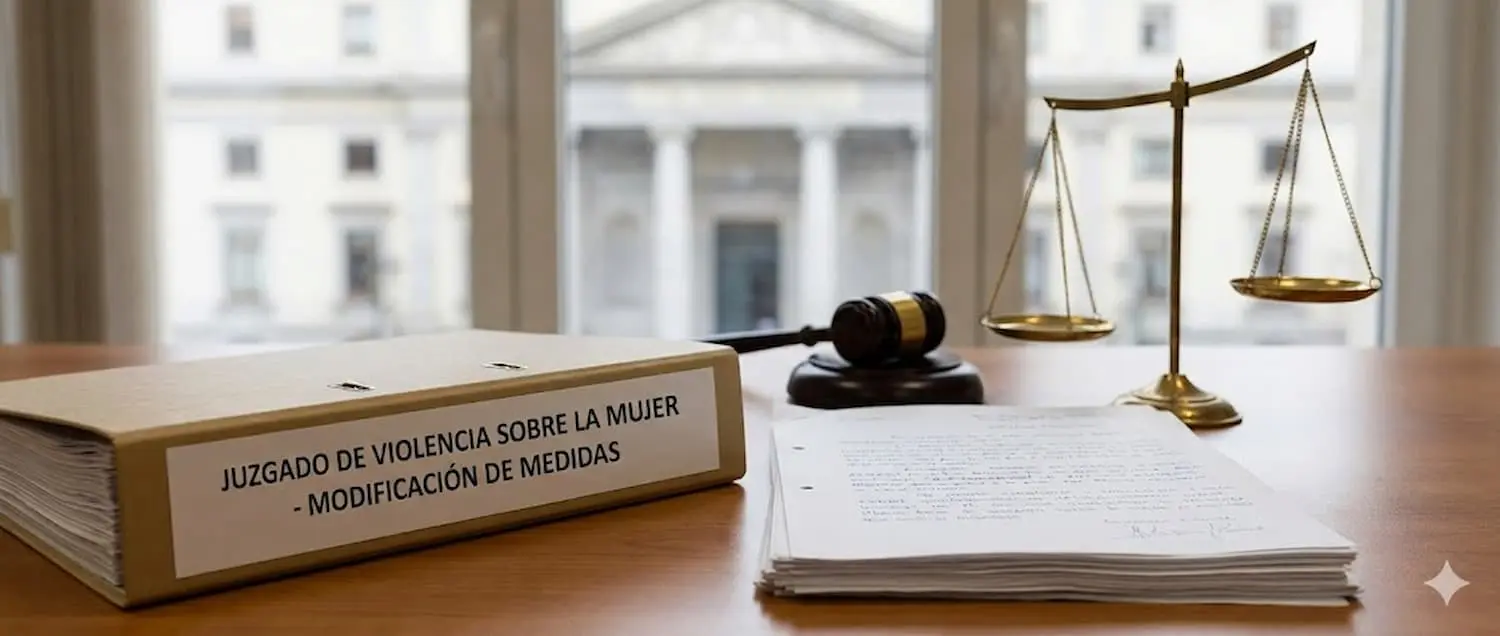
Court file folder of the violence against women court labelled "modification of measures", next to a gavel

In short

Measures agreed in a separation or divorce can be modified when circumstances change substantially (article 90.3 of the Civil Code and article 775 of the Civil Procedure Act). Gender or domestic violence is one of those changes: the Civil Code (Código Civil) rules out joint custody and contact for a parent who is facing criminal proceedings for an attack on the other parent or the children, or where there are well-founded indications of violence, unless the judge gives reasons based on the best interests of the child (articles 92.7 and 94).

When family orders can be changed

A family court judgment is not set in stone. Custody, contact arrangements, use of the family home and child maintenance (pensión de alimentos) can be modified if circumstances have changed substantially and lastingly since they were agreed. Some common examples:

  • A complaint or a conviction for gender or domestic violence.
  • A significant change in either parent’s income.
  • A move to a new home, including abroad.
  • New needs of the children, or their own wishes when they are mature enough.

What the law says when there is violence

Since Organic Law 8/2021, article 94 of the Civil Code (Código Civil) prevents contact arrangements being set in favour of a parent who is facing criminal proceedings for an attack on the life, physical integrity, freedom, moral integrity or sexual freedom of the other parent or the children, or where there are well-founded indications of domestic or gender violence, unless the judge gives reasons based on the best interests of the child. In addition, article 66 of Organic Law 1/2004 requires the criminal judge to suspend contact between a person charged with gender violence and his children, unless a reasoned decision provides otherwise.

A draft Organic Law on measures against vicarious violence, introduced in July 2026, is currently going through the Spanish Parliament (Congreso) and would strengthen these measures. Until it is passed, the rules currently in force apply.

How we do it

  1. We analyse the judgment currently in force and gather evidence of the change in circumstances.
  2. If the matter is urgent, we apply for interim or precautionary measures to protect the children while the proceedings are under way.
  3. We file the application to modify the orders with the competent court, which will be the Violence against Women Section (Sección de Violencia sobre la Mujer) if criminal proceedings are open.

Frequently asked questions

If the parent is facing criminal proceedings for violence against the other parent or the children, the law provides for contact to be suspended, unless the judge gives a reasoned decision based on the best interests of the child. Each case is assessed on the evidence available.

If the criminal proceedings are dismissed or end in an acquittal, the parent concerned can ask for the previous arrangements to be restored or for new ones to be put in place.

Yes, if your income or the children’s needs have changed substantially. Until there is a new court decision, the agreed maintenance remains payable, and failing to pay it can be a criminal offence.

When the circumstances taken into account when the measures in your divorce or separation were set have changed substantially, under article 775.1 of the Spanish Civil Procedure Act and articles 90.3 and 91 of the Spanish Civil Code. A situation of violence that arose later, a protection order or a conviction may justify it, depending on the case. Either parent can apply and, if there are minor children, so can the public prosecutor.

Yes. Article 775.3 of the Spanish Civil Procedure Act allows you to request, in the claim or in the response, provisional changes to the final measures ordered in the previous proceedings, which are handled through the procedure in article 773 of the same Act. This is useful when the children’s situation or yours cannot wait for the judgment on the change.

Yes. Under article 775.2 of the Spanish Civil Procedure Act, if you apply by mutual agreement, or one of you applies with the other’s consent and with a proposed settlement agreement (convenio regulador), the mutual agreement procedure in article 777 is followed. Even so, article 90.2 of the Spanish Civil Code prevents the judge from approving agreements that are harmful to the children or seriously detrimental to one of the spouses. Where there is violence, have any agreement reviewed by your lawyer.

Yes. Article 750.1 of the Spanish Civil Procedure Act requires the parties in family proceedings to be assisted by a lawyer and represented by a court representative (procurador). If you are a victim of gender-based violence, article 20.1 of Spanish Organic Law 1/2004 gives you free defence and representation by a lawyer and court representative in all proceedings directly or indirectly arising from the violence you have suffered.

Yes. Article 92.7 of the Spanish Civil Code rules out shared custody if the other parent is involved in criminal proceedings brought for attacking you or the children, or if there is well-founded evidence of violence. This is normally a substantial change that allows you to request a modification (article 775 of the Spanish Civil Procedure Act), and in the claim you can request a provisional modification while it is being decided. More details on the page on child custody.

Yes. Under article 48.2 of the Spanish Criminal Code, the penalty of a ban on approaching the victim suspends, with respect to the children, the visiting, contact and stay arrangements granted in the civil judgment, until that penalty has been served in full. Even so, to make the situation clear in the long term it may be advisable to adapt the civil measures through an application for modification.

Yes. Article 66 of Spanish Organic Law 1/2004 refers to suspending the accused person’s visiting, stay, relationship or communication arrangements with the children, and article 94 of the Spanish Civil Code allows the right to visit and communicate with the children to be limited or suspended when there are relevant circumstances. If the judge maintains some contact, they must specify how it will take place and adopt safety measures for the children.

You can apply for enforcement of what was ordered. Article 776.3.ª of the Spanish Civil Procedure Act provides that repeated failure to comply with the visiting arrangements, by either parent, may lead to custody and visits being changed if this is in the child’s interest. In addition, keeping a child in serious breach of a court decision is considered child abduction under article 225 bis.2 of the Spanish Criminal Code.

Yes, if circumstances change, because the use of the home is one of the measures that can be modified under articles 90.3 and 91 of the Spanish Civil Code. In the absence of agreement, article 96.1 grants use to the minor children and the parent they live with, until all of them reach adulthood. In addition, a protection order can grant it provisionally, under article 544 ter.7 of the Spanish Criminal Procedure Act (LECrim).

It depends. Article 160.2 of the Spanish Civil Code protects children’s relationships with their grandparents and other relatives, but requires the judge to ensure that those measures do not allow court decisions restricting or suspending the children’s relationship with one of their parents to be circumvented. In other words, the grandparents’ visits cannot become a way for the father to see the children if he is prohibited from doing so.

No, if he is in prison for these offences. Article 94 of the Spanish Civil Code establishes that visiting arrangements will in no case be granted to a parent in prison, on remand or by final judgment, ordered in criminal proceedings for attacking the life, physical integrity, liberty, moral integrity or sexual freedom of the other spouse or the children. If arrangements were already in place, you should apply to have them changed.

Yes. Article 158 of the Spanish Civil Code allows the judge, on their own initiative or at the request of the child, any relative or the public prosecutor, to order measures such as a ban on approaching or contacting the child, or the provisional suspension of parental authority, custody or visits. They can be adopted within any court proceedings, ensuring that the child is heard.

Areas we cover

We assist clients in Alicante and throughout the province

We handle gender-based violence cases throughout the province of Alicante, wherever you live and whichever court is handling your case. These are some of the towns where we work most often:

AlicanteElcheSan Vicente del RaspeigSant Joan d’AlacantEl CampelloMutxamelBenidormTorreviejaAlcoyDeniaCalpeAnd any other town in the province

Every hour counts. Let's talk today.

A confidential first assessment of your case.
Can I help you?